
Story and Illustration by Nhatt Nichols
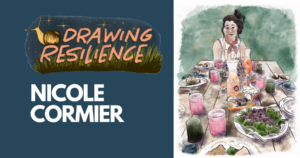
Out in rural Cape Cod, holistic nutritionist and dietician Nicole Cormier is busy weaving community resilience with herbalism, agriculture and clinical practice in one of the only internships of its kind in the U.S. She’s also deeply engaged in feeding community; both her own and those that need additional care and support.
Dietician students who need clinical hours can apply to her program to learn how all the elements of food, from production to plate, can support community health. Cormier created this program out of a desire to bring her guiding principles of roots-to-plate living to the next generation of dieticians.
“My professional lifestyle and my life experiences are all one,” Cormier said. “I really feel like that has been a beautiful way for myself to sustain.”
Those of us in rural communities often find ourselves unable to draw clear lines between our working and personal lives. Living rural can mean bringing every part of you to that community, and Cormier asks her students to dig deep and bring their whole experience into a practice that understands rural resilience.
“The true goal of sustainability is to live in a rural community and have support, have needs be met,” Cormier said. “My hope is to expose these dietetic interns to my rural community, to these concepts, and then have them bring it out through their careers, whether it is a hospital or hopefully working in the community with food incentive programs.”
One of the rotations the interns work is with Sustainable CAPE a nonprofit focused on community nutrition. There they help curate local food bags and write recipes to go with them. The nonprofit is supported by Massachusetts Health, and it works under the principle that food is a type of medicine.
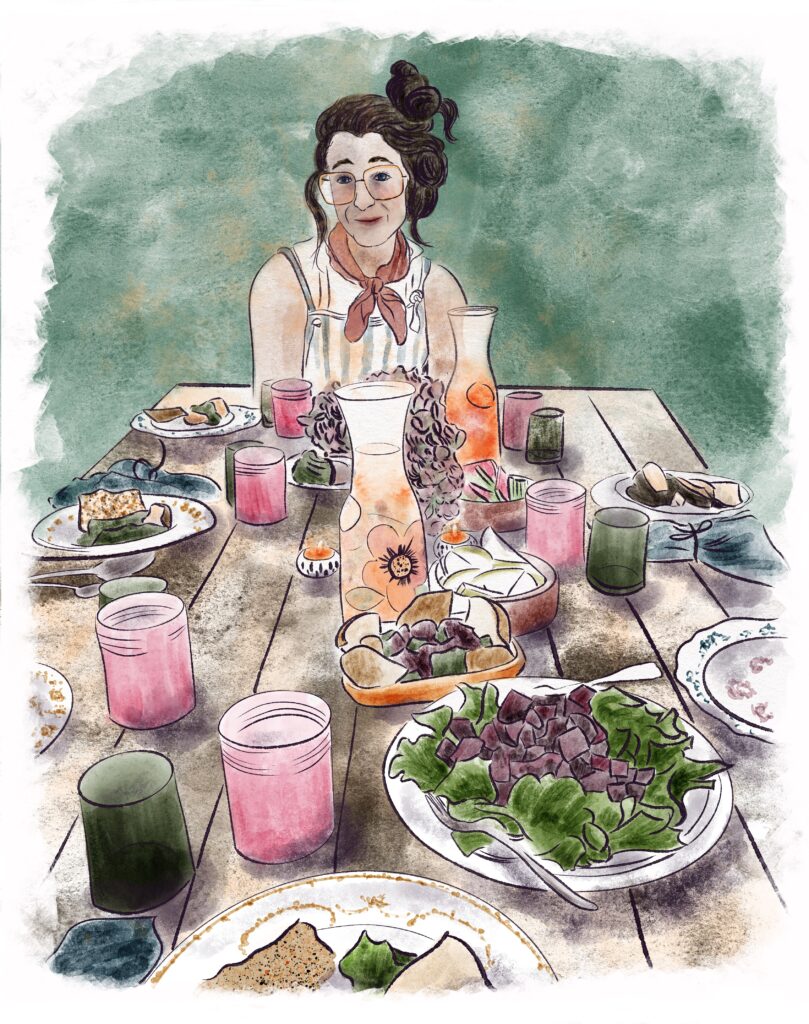
And it isn’t just the act of eating that brings healing. Cormier started the Scrubby Pine Supper Club as a way for her community to gather and learn more about local food. The sliding-scale gathering focuses on sharing information about local foods, and Cormier changes the menu based on what skills and subsistence participants can bring to the meal.
“It’s a true supper club, where I am leading and facilitating it, but I am very open to sharing people’s crafts,” Cormier said. “One woman, she actually is a hunter on the Cape, she was like, ‘Can I bring you some venison?’ And it’s just wild that she was able to share her experience and her form of food gathering for her family.”
Though Cormier is rooted in her Cape Cod community, she also travels to Crowdog’s Paradise in Rosebud, South Dakota every summer to feed participants in a Lakota Sun Dance.
“During the whole purification process, we get to nourish and feed them before they start sun dancing,” Cormier said. But, before long, it became clear to Cormier that more than just the dancers needed sustenance.
“It expanded to whoever came through our camp. So, a lot of the local families would just bring their families for different meals and say, ‘Can we join?’ And we decided to, obviously, just open it up to anyone that came through, and it’s been like such a beautiful experience to be there for that service purpose.”
Cormier creates menus that have nutritionally dense ingredients, offering healthy food not everyone has access to on a regular basis. Though she loves being able to offer her skills, she says the biggest thing she gets out of the experience is listening to the stories of the participants and getting to be in a type of world that is very different from her experiences on rural Cape Cod.
“Traveling and having these experiences are the most valuable foundation for really anyone, no matter who you are,” Cormier said. “Exposing yourself to history directly from the people, it can impact your life in a lot of really challenging but beautiful, honest, authentic ways, and that’s going to plant the seeds of how you choose to spend your money, how you choose to nourish yourself. Being invited into a space where everyone is praying for the same thing, no matter who you are, is really life changing because we recognize how divided we are, and then they’re choosing to invite everybody.”
Inviting everybody extends to the more-than-human world, too. Alongside clinical studies, Cormier has her internists study native plants, exploring the ways they are our allies and kin. During an herbal immersion weekend, dietetic interns are asked to sit down with a plant and meditate, speaking with the plant and cultivating a relationship with it. She hopes that in bringing the more than human world to healthcare professionals, she’s creating a world that uses both knowledge and empathy to cultivate healing.
“Take the time to listen and share; just be present with each other. That’s when we’ll find seeds may come up, that we didn’t realize, ‘oh this person needs this,’ ‘oh my goodness I have access to that,’ or ‘I can help them connect to this.’ But if we don’t take that time and hold that space, we might not see that,” Cormier said, beautifully summing up the importance of being present in rural resilience.
Nhatt Nichols is a multidisciplinary artist and writer raised on top of a mountain in the Okanogan, Washington State. A graduate of The Royal Drawing School in London, she uses drawing, poetry, and comics to break down political and environmental issues, finding new ways to meet people where they are, and ask them to reach deeper into their ability to care and take action.
Drawing Resilience features interviews with leaders who are doing the hard work of staying in—staying in the work, in relationship, in community, even amid deep divisions, systemic injustices, and social and economic challenges—and inspiring others along the way.
Get this and other rural content in your inbox with the Rural Assembly newsletter.