
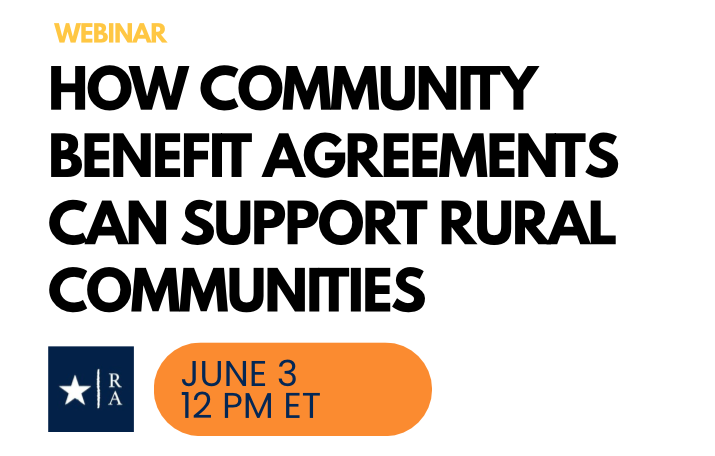
Registration is now open for our upcoming webinar: How Community Benefit Agreements Can Support Rural Communities, June 3, 12 p.m. ET.
Community Benefit Agreements (CBA) are a tool that rural communities can utilize to help secure a future for their community in a way that works for the community. You’ll hear from rural community members who have utilized CBAs. Through their experiences, reflection, and time to connect with others on the webinar, you’ll leave understanding how you might use CBAs in your area. Whether you are navigating data center development or another type of development, join us to learn more about Community Benefit Agreements.
Our guest for the webinar will be Jackson Rose, faculty in the Department of Earth Sciences at Montana State University and Manager of the Geospatial Core Facility. Before joining MSU, he served as Executive Director of a grassroots group in Central Montana, where he led efforts to negotiate a Community Benefits Agreement tied to the Black Butte Copper Project. He has since worked with communities across the West on similar efforts. Drawing on both his scholarly research and that hands-on experience, Jackson was an invited expert panelist for the National Academies’ May 2024 workshop, Leveraging Community Benefit Frameworks: Empowering Communities to Benefit from Federally Funded Energy Projects.
This is second of four educational deep dives presented by the Rural Assembly this year. In March, Rural Assembly gathered with folks from across the country to learn more about the rapid expansion of data centers and the impact of that development in rural areas. (The data center webinar replay is available on Youtube.)
As we closed that webinar, the call to learn more about tools communities can use to support their planning and agency was loud. From that session emerged a theme for the year: Given the inherent power imbalances, how do small and rural communities navigate big outside pressures? Together with Radically Rural and presenter Annie Contractor, we are preparing three webinars that will answer this call for more tools and address the question of how rural communities can navigate outside pressures.
We look forward to learning with and from you this year. Want to hear about future webinars? Sign up for the Rural Assembly newsletter.
June 3 | 12 p.m. ET
Presented by Rural Assembly, Radically Rural, and Annie Contractor