
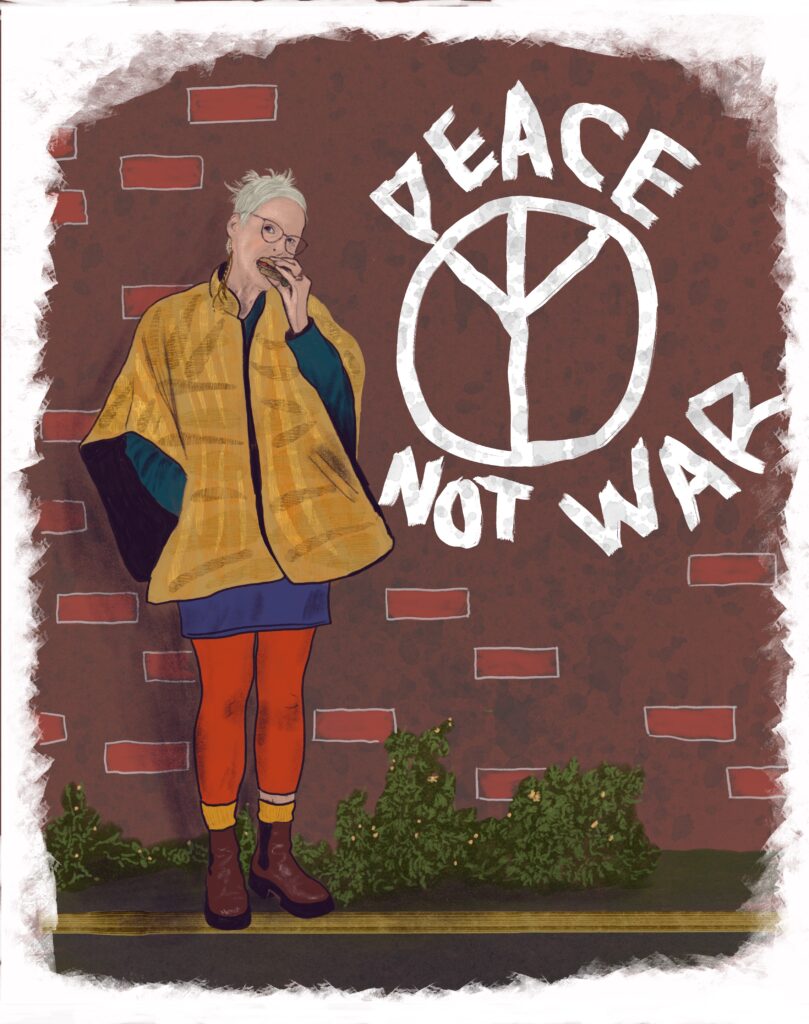
Illustration and Article by Nhatt Nichols
What I wear isn’t always at the top of my list when I think about how rural resilience manifests in my life. However, that doesn’t mean it doesn’t play a large part in how I build my identity and recognise like-minded people in my community, something that’s especially important for those of us who are rural and queer. And if it’s important to me, now, as an adult, it’s critical for young people in rural places.
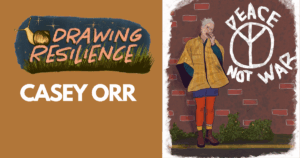
Photographer Casey Orr has been documenting the ways people find each other, and themselves, through how they present themselves to the world her entire career. She’s an American photographer who lives in the UK, showing her work in galleries and museums in both countries. Orr has worked with prisoners in Leeds, England, and travelled across Europe photographing anarchists. Her current project focuses on rural young people in northern England and eastern Washington State.
“I’m interested in what young people are doing in terms of what their identity is, how they present themselves, and how the language of who they are can be read through fashion,” Orr said, “because I think that they’re telling us where we’re going.”
Orr describes fashion as being its own sophisticated language, signalling the wearer’s beliefs and worldview like a beacon, drawing queer and marginalised young people together. “It just blows me away, the kind of bravery and creativity that’s happening outside of the cities, in communities that wouldn’t normally welcome a diverse range of identities.”
Her photos show young people of all ages looking stunningly confident in themselves and their place, wild hair and makeup against colorful backgrounds. Each kid looks comfortable in their own skin, and Orr says that one of the most valuable parts of her work has been introducing kids to one another, and to their most resilient selves, through their photographs.
“The project has been going on for so long now that 18 or 19-year-old freaky LGBTQ plus kids can be seen by a kid who’s 12 or 11 or whatever, who’s kind of like, oh, that’s who I am, and I’m from that community,” Orr said. Being able to reflect identity back to marginalized rural kids is one of the ways she helps them build the kind of community resilience that allows them to be themselves.
Her current project takes that reflection one step further by connecting kids she’s photographed in northern England, where she now lives, with kids growing up in Twisp, Washington, roughly 70 miles from where I grew up surrounded by apple orchards, ranchers, and survivalists.
Twisp is a small town with a reputation for being more liberal than the rest of conservative Okanogan County. Orr, who is originally from Delaware, has an old friend who has been working with a youth community organization in Twisp and knew how much the kids she worked with could use the kind of culture-affirming work that Orr does. They are planning on showing the photos from both rural England and Twisp together, and giving the students a chance to speak with each other online afterwards.
“Part of this project is also thinking about how I do the thing that I do, but also create community networks and solidarity between the two different places,” Orr explained. “They need to create their networks, and it needs to be international, and they need to be talking about what’s going on for them and how they can support one another.”
I wonder how my own life would have been different if I had been exposed to other queer rural kids in another part of the world. I can’t help imagining that the knowledge that I’m part of something that makes sense outside of my daily experiences would have helped me understand who I was sooner, and would have given me the ability to be more comfortable standing out in very rural Okanogan County.
The benefits of projects like this seem obvious, but it takes a special kind of adult who can make a young person feel safe. Orr explains her process as being one of creating trust through curiosity, a lesson all of us can bring to community interactions.
“I never step in with certainty. There’s all this uncertainty about it, and for them, and trust that they will enable me to see them. And so it just feels really exciting.”
If you would like to see Orr’s past projects, visit https://www.caseyorr.com/
Drawing Resilience features interviews with leaders who are doing the hard work of staying in—staying in the work, in relationship, in community, even amid deep divisions, systemic injustices, and social and economic challenges—and inspiring others along the way. To get this feature and more in your inbox, subscribe to the Rural Assembly newsletter.